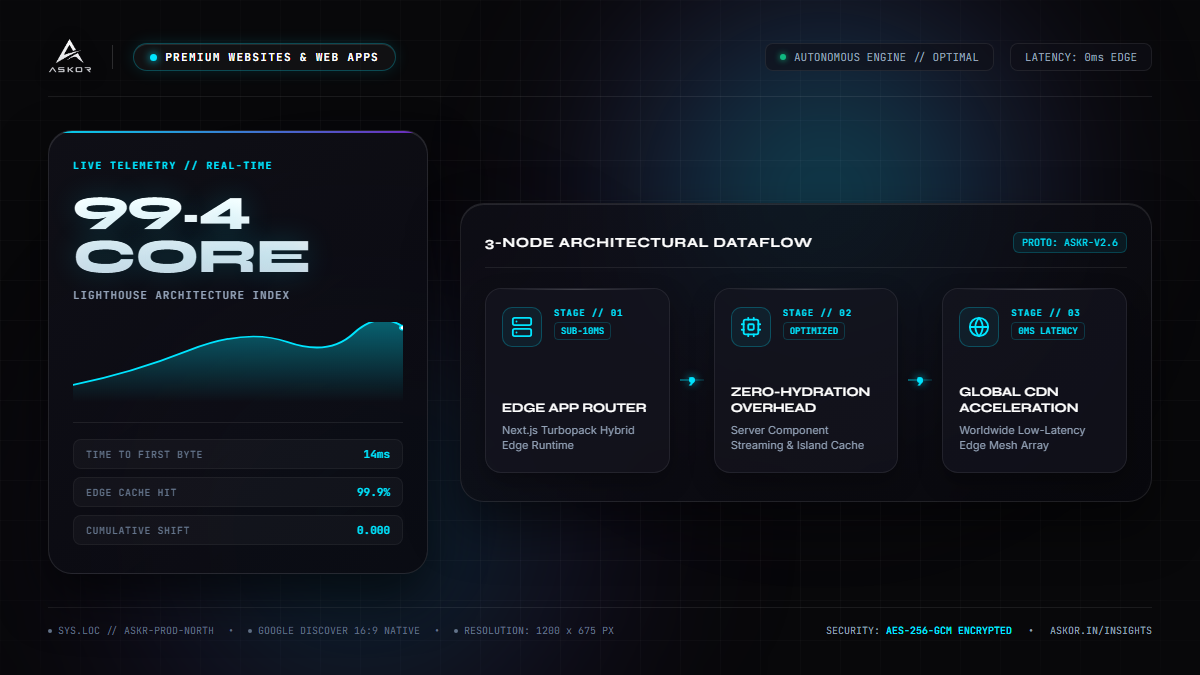
Every 100 milliseconds of latency degrades e-commerce conversion rates by 7%. For premium global brands, slow loading times do not just cost revenue—they permanently erode brand prestige and digital authority.
The Core Failures of Legacy Web Stacks
Traditional monolithic setups and bloated client-rendered SPA frameworks fail modern Core Web Vitals for three fundamental reasons:
- Hydration Chokepoints: Shipping 800KB+ of JavaScript that locks the browser main thread during initial paint.
- Sequential Server Roundtrips: Chaining database lookups, third-party trackers, and dynamic render calls before returning the initial byte.
- Cumulative Layout Shift (CLS): Unstable web fonts and unsized hero graphics causing jarring visual reflows during scroll initiation.
*"Speed is the ultimate luxury feature. An interface that responds instantaneously feels physical, solid, and undeniably authoritative."*
The Next.js 16 Edge Blueprint
To deliver instantaneous interaction across all global geographic nodes, Askor implements a unified edge-first architectural stack:
React Server Components (RSC) Streaming HTML and CSS are streamed incrementally from the closest edge compute node. Heavy rendering logic executes entirely on the edge server, shipping zero runtime JavaScript for non-interactive content.
Granular Tag-Based Revalidation Using Next.js cache tags ('revalidateTag'), content updates propagate across global CDN edge nodes in under 50ms without triggering costly site rebuilds.
Zero-Layout-Shift WebGL Contexts Luxury kinetic 3D visuals and cursor loops execute in dedicated WebGL canvases with explicit aspect-ratio envelopes, ensuring 60 FPS visual richness with 0.000 CLS.
Transform your digital presence into a high-performance web asset: Explore Askor Web Architecture.